Our History of Flourishing
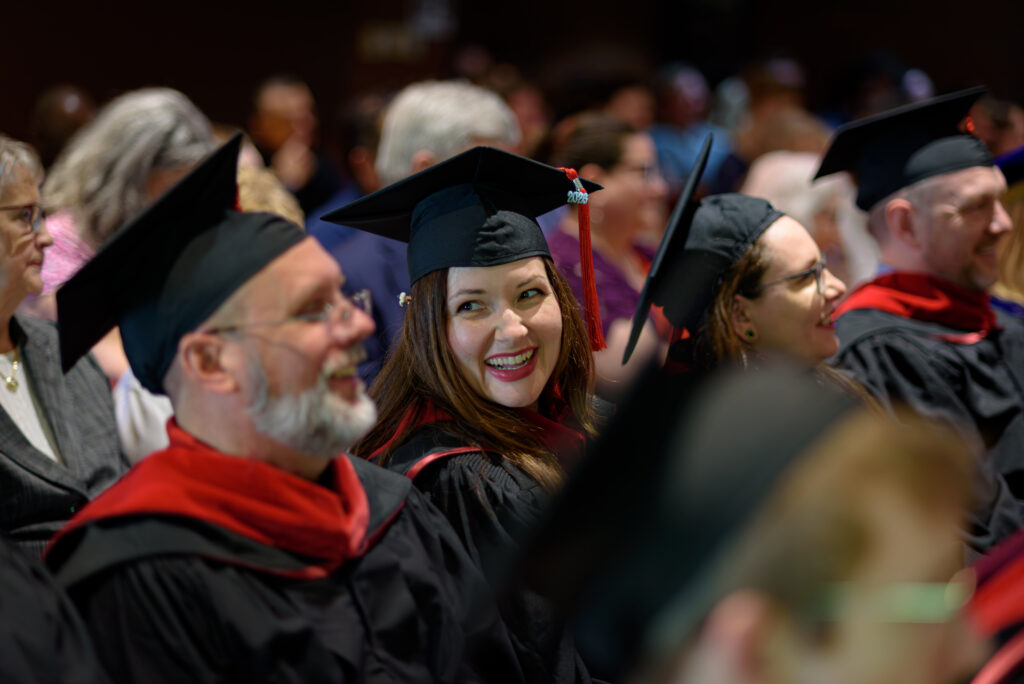
Bethany Theological Seminary has now been in Richmond for 32 years, the longest it has been in any location. When the Seminary sold its campus in Oak Brook, Illinois and entered into a partnership with the Earlham School of Religion, many people believed the leaders were making a mistake that would hasten the end of an institution that was already struggling. Decades on, however, it has thrived.
In May, Bethany conferred 40 master’s degrees and graduate certificates. It was the largest class to graduate in Richmond, but also larger than many groups that received their degrees in the suburban Chicago days, dating at least to 1963. Looking back from the vantage point of 2026, it’s clear that the Seminary has made the most of a very difficult situation and found success in some areas that wouldn’t have been predicted in the early 1990s.
Dr. Gene Roop, who served as Bethany’s president 1991-2008 notes that double-digit inflation in the 1980s had led the Seminary to borrow all it legally could from its endowment. At the same time deferred maintenance on its Oak Brook campus had mounted.
“Financially, there was no doubt we needed to change,” Roop recalls. He also points out that by the early 1990s, it was already the case that many students had spouses with professional careers and were unwilling to relocate to attend seminary. As a result, a large campus with plenty of housing was no longer practical or necessary.
Dr. Roop taught at Earlham School of Religion from 1970-77, before joining the Bethany faculty. He was familiar with the strengths and needs of both institutions. He could envision how the two institutions could form a successful partnership before others shared his vision. Dr. Roop also put his faith in the Bethany community, which has shown itself capable of adaptation and change.
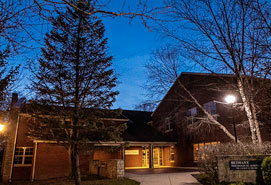
Bethany’s adaptability to change continued to be a strength as it embarked on a new chapter, relocating to Richmond in 1994. Thanks to the volunteer labor of Brethren volunteers, Bethany constructed the Bethany Center, an effort led by Ivan Patterson, who owned a thriving plumbing business in the Dayton, Ohio, area. The seminary benefited from a lower cost-of-living for faculty and staff, and selling the Oak Brook campus freed the institution from the costs associated with maintaining a large campus, and provided a much-needed influx of cash.
The Seminary also placed student needs and interests at the center of its educational experience, and shaped its offerings accordingly. By the 1990s, it was already obvious that many students who were interested in a Seminary education were not necessarily interested in relocating in order to pursue their studies. Many seminarians had spouses with careers of their own and established lives in other parts of the country. The Seminary began to offer many courses in formats — like weekend or weeklong intensives — that allowed students to engage with educational programs without committing to a traditional in-person semester schedule. And in the early days of the internet, Bethany harnessed technology to connect its educational offerings to more students.
By adopting distance learning in the early 2000s, and by committing to consistent investments in technology, Bethany prepared itself for the fundamental changes that have taken place in higher education in recent decades. Dr. Roop notes that faculty members weren’t initially excited about the adjustments that distance education required for their pedagogy, but they understood that change was essential in order for Bethany to continue to serve its students.
“We continue to think creatively about course delivery, knowing that many students want to stay in place and study at a distance. Our faculty have been effective in offering distance education through synchronous video conferencing that is very high quality,” notes Dr. Steve Schweitzer, academic dean.
The early adoption of distance education technology has allowed Bethany to attract an increasingly diverse population of students and it has provided Bethany faculty the opportunity to become very effective in their use of technology and in curating the classroom experience in video conference settings. Indeed, the Seminary was so used to providing a quality experience to students studying at a distance that when the Covid pandemic hit, the Seminary had a much easier time responding than many other schools. Bethany’s investments in technology and commitment to creating rich and engaging online classroom environments is a major part of its steadfast commitment to access and affordability to all qualified students.
About 90 percent of Bethany students now study at a distance. They come from a wide variety of backgrounds and represent a variety of Christian denominations, though the Seminary enrolls many Church of the Brethren students in its Master of Divinity program. Students are often already serving in ministry when they enroll. Many students are seeking to serve and lead outside of traditional search settings, but they find Bethany’s grounding in Anabaptist and Pietist witness to be powerful and relevant.
Bethany professors always have been adventurous and innovative thinkers who are focused on creating courses and programs that match the interests and needs of their students. Over last decades, they have listened to the changing interests and needs of students. In response, the Seminary has dramatically expanded its offerings to five master’s degrees and nine graduate certificates.
“Our faculty have also been very innovative and creative in developing new programs that help students develop skills that they can apply in new ways,” says Schweitzer. “Bethany prides itself on being flexible, creative, and adaptive. So if you are a student coming in, there are a wide variety of programs that allow you to find where you want to go, and to adjust along the way.”
At the time of the move, many questioned whether Richmond, Indiana — a small city in rural Indiana with a declining population and little connection to the Church of the Brethren — could be a sustainable home for Bethany. Decades later however, the Seminary built strong connections to the local community by sponsoring arts and community events, and encouraging students and employees to be active volunteers. The Seminary has also leveraged the community’s low cost of living by purchasing and rehabbing several houses that provide residential students a free place to live — a key element of Bethany’s commitment to affordability.
Bethany has also transformed its building into a community gathering place, hosting classical music recitals, board meetings for local organizations, educational events sponsored by outside groups, and even birthday and graduation celebrations for family members of employees. The result of these efforts is that the Seminary has become well known as a good neighbor in its community. Bethany has also been a prominent sponsor of local organizations like Richmond Symphony Orchestra, Richmond Civic Theatre, and Wayne County Chamber of Commerce. The Seminary’s role in the community transcends its relatively small size.
Over the last decade, Bethany has experienced remarkable success — doubling its enrollment while creating a pathway for all students to graduate without new debt. The Seminary recently exceeded its goal of raising $12 million during Flourish: A Campaign for Bethany Theological Seminary. The recent $10 million grant from Lilly Endowment has allowed the Seminary to offer courses to exceptional students at the six Brethren colleges and universities. Our program in Nigeria continues to thrive, as we have added a full master’s degree program designed for those students and twice celebrated commencement ceremonies in Jos. President Jeff Carter notes the specifics of the Seminary’s current activities are rooted in traditions that date to the institution’s founding.
“I believe the strongest link between Bethany’s past, present, and future is the founder’s vision,” says Carter. “The vision of spiritual empowerment, strong biblical scholarship, and an education rooted in practical experience — that approach is durable. It is lasting. And we continue to lean into it with each generation.”
Lori Current, executive director of student services, believes that with these exciting initiatives, the Seminary will provide transformative education opportunities to an increasingly diverse cross-section of students. She hopes that from its home base in Richmond, Bethany will continue to be a positive force in the lives of students from across the country and around the world.
“These days, students are choosing Bethany for the flexibility we provide. They like the option of coming to campus for an intensive course, or living here and participating in Bethany BOLD, as well as distance learning. They are also drawn to the ecumenical learning environment. They like being in classes with like-minded people, as well as those who have views they are encountering for the first time. Students also appreciate opportunities to engage in practical ministry.” She adds, “I hope that Bethany will always continue to be student-centered, providing students with whatever they need to be successful.”
####
This article originally appeared in the Summer 2026 issue of Wonder & Word magazine.


 Green Circle: Bethany invests in 100% renewable energy.